
Review status: This lesson is not presented as reviewed, approved, or endorsed by Shawna. Educational review status is managed separately and shown in The Color Corner library when established.
Reading the color wheel with intention
Master primary, secondary, and complementary relationships with a practical framework you can apply chairside to neutralize unwanted tones and build more predictable results.
- Time
- 18 min
- Level
- Foundation
- Context
- The Color Corner
- Review date
- July 2026
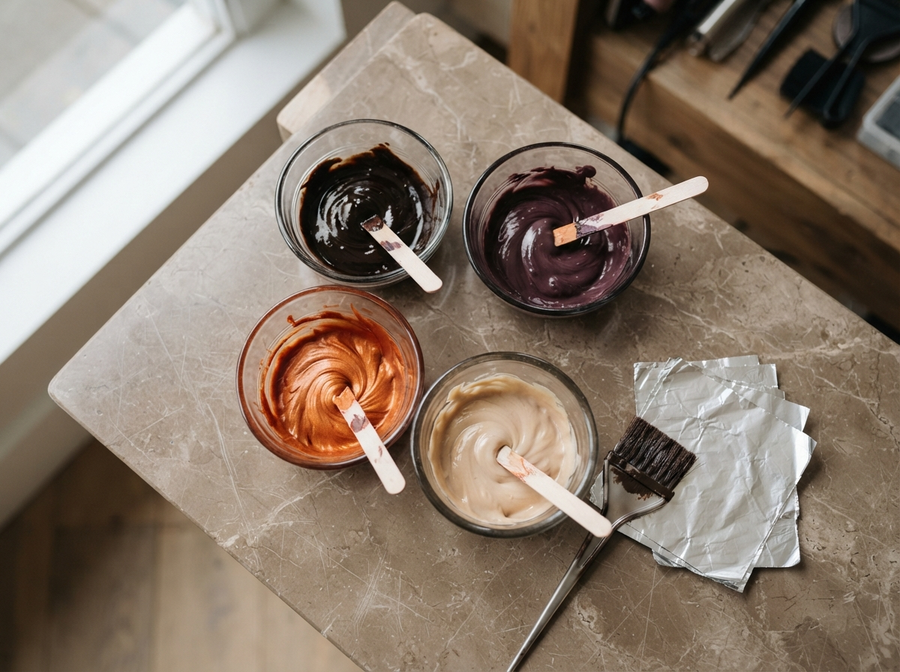
Lesson visual inside Color Me with Shawna
What you will learn
- Name primary, secondary, and tertiary relationships with the speed of instinct, not recall
- Predict undertone progression by level family — what surfaces, how strongly, and why
- Use complementary placement as a nuanced decision tool, not a blunt neutralization reflex
- Translate wheel logic into consultation language that builds trust without a lecture
Materials
- 12-point RYB wheel printed at true hue, not stylized pastel
- Level system chart (1-10) with natural underlying pigment noted per level
- Warm and cool swatch families in consistent light
- Daylight lamp or north-facing natural light for observation
Safety note — preserved
Color theory foundation. No chemical procedures are covered in this lesson. Always perform strand tests and follow manufacturer instructions for any chemical service. Theory informs decision-making; it does not replace tactile assessment.
Step-by-step — The Color Corner · Color Me with Shawna
Start with three colors and one honest question
Red, yellow, blue. Place them on the wheel and ask: what does each do to hair when isolated? Red adds visual weight, holds warmth, and resists leaving. Yellow lifts fast, exposes quickly, fades first. Blue cools and tightens visual perception, can close down dimension if over-applied. Most education rushes past this as basic. Beth Minardi taught a generation that color as art starts here — lingering on what primaries do alone before you ever mix them. Shawna's note: Most corrective mistakes I have seen in 34 years trace back to forgetting what the primaries do alone before we mixed them. Stay here longer than feels productive. Why this matters: Formulation errors rarely start at mixing. They start here, in a shallow relationship with primaries you thought you already knew.
Secondaries are where lift becomes visible to the eye
Orange, green, violet. These are not abstract. When you lift a natural level 4, you physically pass through red, then red-orange, then orange. That progression is the wheel in action under the surface — pigment revealing itself in stages. Place secondary swatches next to real level swatches. Notice how orange at level 7 requires a different tonal decision than orange at level 5 — same family, different intensity and weight. The wheel tells you what is present. The level tells you how strongly it presents. Sue Pemberton's curriculum precision lives here: document what you see at each level before you ever discuss correction. Why this matters: When you can name what the hair is doing by level, you stop reacting to warmth and start anticipating it.
Complementary placement is careful subtraction, not cancellation as punishment
We say blue cancels orange. What we mean is blue visually reduces the perception of orange warmth in that zone — it does not remove underlying pigment. Practice placing complementary swatches at equal depth before ever placing them on hair. Look at blue placed over level 6 orange versus level 8 yellow-orange. Same complement family, profoundly different result in depth and softness. Document what you see. This habit — equal-depth observation on paper before hair — is the difference between toning that looks natural and toning that looks muddy or overcorrected. Lisa Kelley always reminded us that formulation is chemistry you respect, not chemistry you overpower. Why this matters: Muddy results are almost never a product problem. They are a depth-mismatch problem from complementary placement without equal-depth awareness.
Translate theory into a chairside decision tree clients can feel
Shawna uses three questions before any formulation thought: What level am I seeing right now in natural light? What undertone is dominant in that level? What direction does the client want to move — and why? The wheel answers the second question. Your eyes answer the first. The client answers the third. Write these three answers in your consultation notes before you mix anything. When you return to formulation, you return to documented observation, not memory. Tracey Cunningham models this contemporary consultative approach — curiosity first, formulation second, both with intention. Why this matters: Great consults feel calm because they have structure. This three-question tree is yours to keep.
Build a consultation sentence that teaches without overexplaining
Try: I am seeing a lot of natural warmth at your level, which tells me you have beautiful strong pigment to work with. If we want a cool result, I will need to account for that warmth in how I build your formulation so we do not spend the month fighting it between appointments. Clients do not need a wheel lecture. They need to know you saw what is there and you have a reason for your approach. Shawna's note: I have never had a client ask me to show them the wheel. I have had hundreds ask me if I saw what they were seeing. Answer that question first. Why this matters: Education language builds authority. Consultation language builds trust. Learn both, and learn when to use which.
Key takeaways
- The wheel describes relationships, not rules. Level and porosity change how those relationships show up chairside.
- Document observed undertone at natural level before discussing formulation. Your future self will thank you when you see this client again.
- Neutralizing is visual reduction of warmth perception, not pigment removal. Respect what remains underneath.
- Use consultation language that honors both the science and the person in front of you — observation plus care.
Professional note · Review status not established
Shawna keeps a small wheel in every consultation kit she has owned since 1992. Not to show clients, but to check herself before she mixes. What separates good colorists from great ones here is not knowledge of complements — every student knows blue and orange. It is the discipline to place swatches at equal depth on paper before placing anything on hair, and to name level first, undertone second, client desire third. Theory is not a beginner topic you graduate from. It is the filter every advanced correction passes through. Revisit this lesson quarterly. The wheel does not change. You do.